 10 years of water leakage warranty for Regrouting showers.

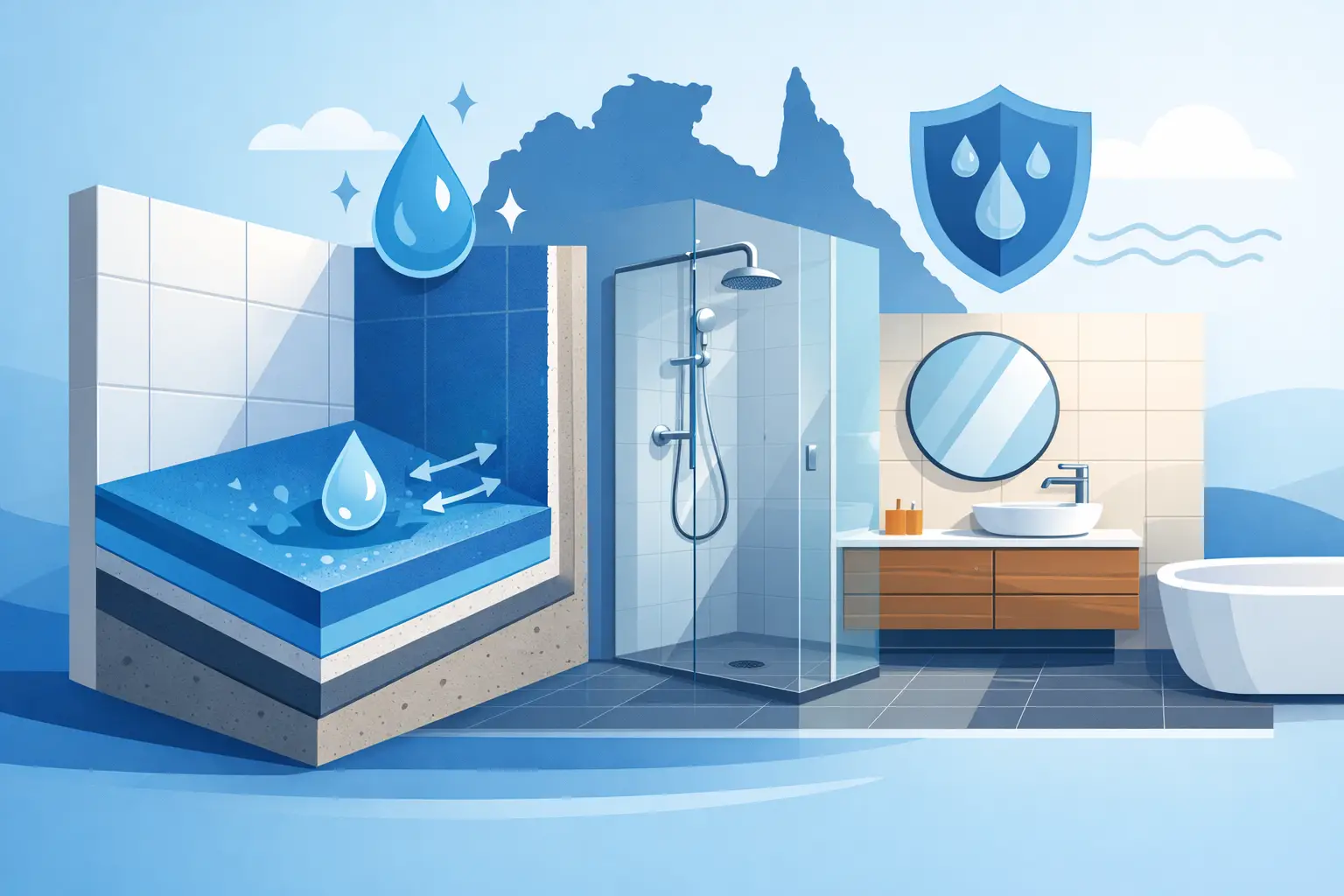
A shower can look immaculate while moisture is quietly reaching the wall framing, subfloor or adjoining room behind it. That is why a proper waterproof membrane review should focus on more than the product name on the bucket. The real measure is whether the complete system has been specified, prepared and applied with the precision needed to protect the space for years.
For homeowners, renovators and property managers, waterproofing is one of the least visible parts of a bathroom upgrade – and one of the most consequential. Tiles, grout and silicone create the finished appearance, but they are not the primary waterproof barrier. The membrane beneath the tiles is what helps manage water where it matters most.
What a Waterproof Membrane Must Do
A waterproof membrane is a continuous barrier applied to wet-area substrates before tiles are installed. In a bathroom, this usually includes the shower floor, shower walls, wall-to-floor junctions, penetrations around plumbing fittings, and other areas exposed to water.
Its role is straightforward: it stops moisture from travelling through tile joints, grout lines and substrate surfaces into the building structure. A correctly installed membrane also needs enough flexibility to accommodate minor movement without splitting, while maintaining reliable adhesion to the surface beneath it and the tile adhesive above it.
This is why visual presentation alone cannot determine waterproofing quality. Fresh grout, straight tile lines and polished fittings all matter, but they cannot compensate for poor substrate preparation, thin coverage, untreated corners or rushed drying times.
In Australian wet areas, waterproofing work should be planned with the relevant requirements of AS 3740 in mind, alongside the product manufacturer’s instructions and the conditions of the particular site. A ground-floor concrete bathroom, an upper-level ensuite and a balcony each present different movement, drainage and exposure considerations.
Waterproof Membrane Review: The Main System Types
There is no single membrane that suits every tiled project. The right choice depends on the location, substrate, tile finish, drainage design and the condition of the existing space. The strongest results come from selecting a compatible system rather than choosing on price alone.
Liquid-Applied Membranes
Liquid membranes are commonly used in residential bathrooms because they can be rolled, brushed or trowelled onto prepared surfaces. Once cured, they form a flexible waterproof layer beneath the tiling.
Their main advantage is coverage around corners, hobs, pipes and irregular layouts. In a well-prepared shower, a liquid system can create a continuous barrier with relatively few joins. It is also practical for many renovation projects where walls and floors need careful detailing around existing services.
The trade-off is that application quality is critical. Coats must be applied at the required thickness, allowed to dry correctly and reinforced at junctions or penetrations where specified. A membrane that is too thin or patched inconsistently may not perform as intended, even if it initially looks neat.
Sheet Membranes
Sheet membranes are manufactured waterproof sheets bonded to the substrate with adhesive or a compatible bedding method. They offer controlled thickness and can be an excellent choice where a consistent layer is required or where site conditions call for a particular system.
They require very careful treatment at seams, corners and overlaps. If the sheet is damaged, poorly bonded or joined without the correct sealing method, water can find a path behind it. This is specialised work, particularly around drains and shower recess details.
For larger commercial spaces or projects with demanding performance requirements, sheet systems can offer strong predictability. For smaller residential bathrooms with complex shapes, a liquid-applied system may be more practical. The answer depends on the full installation, not simply the membrane category.
Cementitious and Hybrid Systems
Some waterproofing products use cement-based or hybrid formulations. These may be suitable for particular substrates or tile applications and can offer useful adhesion or durability characteristics. However, they are not interchangeable with every adhesive, substrate or finish.
A quality installation considers the whole assembly: substrate preparation, primer, membrane, tapes or bands, adhesive, grout, silicone and drainage. Mixing unrelated products without confirming compatibility can compromise both performance and warranty coverage.
The Details That Decide Long-Term Performance
Most waterproofing failures do not begin in the middle of a broad wall. They begin at transitions and penetrations – the places where materials change direction, meet a fitting or are exposed to repeated movement.
Wall-to-floor junctions, internal corners, shower hobs, drainage points, taps, mixers and pipe penetrations need particular attention. These areas often require bond breakers, reinforcing tape, pre-formed corners or compatible collars as part of the membrane system. Skipping these components to save time is a false economy.
Drainage also matters. A membrane cannot solve water that is allowed to sit in the wrong place. Shower floors need appropriate falls so water moves efficiently towards the waste rather than pooling in corners or tracking beyond the shower area. Good tiling work supports this function through precise set-out, suitable tile selection and careful finishing around the drain.
Substrate condition is equally important. Membranes need clean, stable and properly prepared surfaces. Loose sheeting, movement in the floor, contaminated concrete, cracked substrates and residual moisture can affect adhesion. Before waterproofing begins, underlying problems should be repaired rather than covered over.
Why Grout Is Not a Substitute for Waterproofing
This is a common point of confusion, especially when a shower starts showing mould, cracked joints or discoloured grout. Quality grout and silicone are essential to a clean, durable tiled finish, but they are not a replacement for the waterproof membrane behind the tiles.
Grout is porous to varying degrees and can absorb moisture over time. Silicone seals movement joints and changes of plane, but it requires maintenance and eventual replacement. The waterproof membrane is the concealed layer designed to protect the structure if moisture passes through surface finishes.
Regrouting can be an excellent solution when the membrane is sound and the issue is limited to worn, cracked or stained grout. It refreshes the appearance of a shower, improves hygiene and helps reduce surface water entry. However, persistent leaks, soft walls, loose tiles, swelling skirting boards or water marks in adjacent rooms may indicate a deeper issue. In those cases, regrouting alone will not restore a failed waterproofing system.
A careful inspection should identify whether the problem sits at the surface or beneath it. This protects property owners from paying for cosmetic work when more substantial repairs are needed.
How to Assess a Waterproofing Proposal
When reviewing a bathroom renovation or repair scope, ask clear questions about the waterproofing stage before tile installation begins. A professional should be able to explain which areas will be waterproofed, how corners and penetrations will be treated, which products are being used and how curing times will be managed.
It is also reasonable to ask whether the proposed membrane is compatible with the substrate and tile adhesive, and whether photographs or documentation will be provided before tiles cover the work. This record can be valuable for future maintenance, property sales and warranty discussions.
Price deserves context. A low quote may exclude proper preparation, reinforcement materials, drainage corrections or adequate drying time. Those omissions are difficult to see once the tiles are installed, but they can become expensive when water damage appears later. A detailed scope gives you a clearer basis for comparing workmanship rather than comparing a single figure.
For occupied homes, planning is particularly important. Bathroom waterproofing can involve curing periods that affect when tiling and fixture installation can continue. A reliable contractor sets realistic expectations and protects adjoining finishes while work is underway. Clean work practices, accurate sequencing and clear communication are all part of a quality result.
Choosing Quality Beneath a Flawless Finish
The best membrane is not necessarily the most heavily marketed or the most expensive product. It is the system suited to the room, installed over a sound substrate and detailed correctly at every vulnerable point. That combination gives your tiles, grout and fixtures the stable foundation they need to perform beautifully.
At A1 Grouting & Tiling, we approach tiled spaces with the same attention to concealed preparation as visible finish quality. Whether a project involves a fresh bathroom installation, a shower repair or a full tiled upgrade, the aim is a clean, refined result built for lasting performance.
Before committing to surface repairs or a renovation, have the wet area assessed honestly. A precise diagnosis at the start can preserve the finishes you love, protect the structure behind them and give your bathroom the confidence of workmanship done properly.